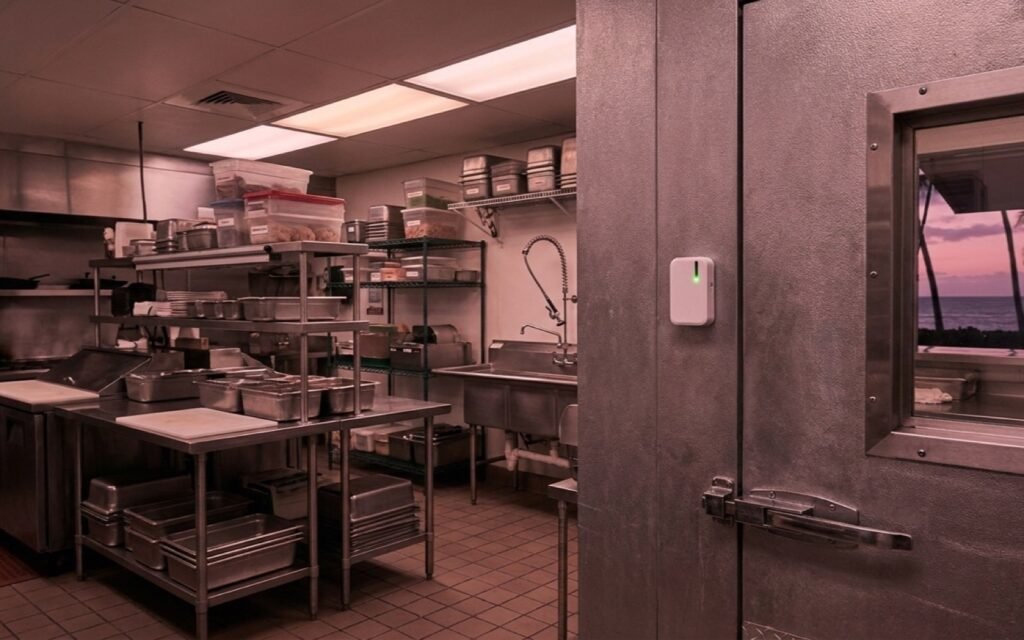
The compressor on the walk-in fails at two in the morning on a Saturday. Nobody is there. The alarm on the unit beeps to an empty kitchen for thirty hours, and the first person to know is whoever opens on Monday and notices the smell.
The cost is not just the food. It is the food, plus the service you cannot run while you replace it, plus the emergency call-out rate on a Sunday, plus explaining to a health inspector why your temperature log has a gap in it. A single failure like that will often cost more than a decade of monitoring the freezer would have.
This is the practical end of what gets sold as the Internet of Things, and the term is doing the technology no favors. Stripped of the jargon it is three things: a sensor that watches something, a connection that carries the reading somewhere, and a rule that wakes a human when the reading goes wrong.
Where It Pays for Itself Fastest
Some deployments are genuinely speculative. These are not. They tend to pay back on the first incident they prevent.
- Cold storage temperature. Walk-ins, reach-ins, freezers, and refrigerated cases. The highest-value sensor most food businesses will ever install, and the same applies to clinics and pharmacies holding temperature-sensitive stock.
- Water leak detection. Under sinks, behind water heaters, near any equipment room. Water sensors cost very little and a slow leak discovered late is a floor, a ceiling, and a closure.
- Equipment runtime. Compressors and HVAC units that begin running longer to hold the same temperature are usually telling you they will fail soon. That is a repair scheduled on a Tuesday instead of an emergency on a holiday weekend.
- Doors and access. Which doors opened, when, and by whose credential. Useful for security, more often useful for settling questions about what actually happened.
- Asset and vehicle location. Where the trucks are, where the expensive portable equipment went.
The Math Is About Avoided Loss
Most technology gets justified by efficiency, which is hard to measure and easy to argue with. This one is different, and it is worth doing the arithmetic honestly.
Take your single worst realistic incident. The full value of what is in the walk-in, plus the revenue you lose while it is out, plus emergency service at weekend rates. Then ask how likely that is over five years, given the age of your equipment. Compare it against the cost of sensors and a monitoring subscription over the same period.
For most businesses with refrigeration the answer is not close. For businesses without anything perishable or water-sensitive, it often is close, and the honest recommendation may be to skip it.
The Questions That Decide Whether It Actually Works
Sensors are the easy part and the part vendors want to demonstrate. What separates a system that saves you from one that quietly does nothing is everything downstream of the reading.
- How does an alert reach a person at 2am? An email nobody reads until morning is not monitoring. You want a call or a text, an escalation path when the first person does not answer, and a named second person.
- What happens when the internet goes down? If the sensor reports over your network and your circuit fails, you lose visibility at exactly the moment problems tend to cluster. Cellular backup on the monitoring gateway is often worth more than additional sensors.
- What happens when the power goes out? Battery backup on the gateway, and sensors that keep recording locally and upload when they reconnect.
- How long do the batteries last, and who changes them? Unglamorous, and the single most common reason these systems stop working. A sensor with a dead battery looks identical to a sensor reporting no problem unless the system flags it.
- Does it log history, or only alert? This matters more than it sounds. See below.
- Who owns acting on it? If an alert fires at 2am and reaches someone who has no authority to call a repair company, you have bought a notification, not a solution.
The Compliance Side Is Underrated
If you handle food or temperature-sensitive medical stock, you are probably already keeping temperature records, most likely on a clipboard, filled in by whoever remembers, sometimes retroactively.
Continuous automated logging replaces that with a record nobody has to remember to create. It is more accurate, it is available when an inspector asks, and it does not have gaps on the days someone called in sick. In some settings, continuous digital logging is not merely convenient but expected, so check what your specific rules require rather than assuming your current clipboard is sufficient.
Worth knowing: this benefit shows up every single day, while the dramatic 2am save may never happen. For a lot of businesses the paperwork is the real return and the emergency alert is the insurance.
Alert Fatigue Is the Real Failure Mode
These systems rarely fail by breaking. They fail by crying wolf.
Set the thresholds too tight and the freezer alerts every time someone props the door open to load a delivery. Within a month the alerts are muted, and the system is now decoration that you pay a subscription for.
Good practice is boring: set thresholds so an alert means something is genuinely wrong, use a duration rule so a brief door-open does not trigger, and treat every false alarm as a tuning problem to fix rather than something to live with. If your team has learned to ignore the notifications, the system has already failed regardless of what the dashboard shows.
Start With One Thing
The failure pattern with this technology is buying a platform. The successful pattern is putting sensors on the one or two things whose failure would hurt most, running that for a season, and expanding only if it earns it.
Pick the asset that would cause the worst day. Usually that is the walk-in. Start there.
How I Fit In
I am a consultant and a partner with OTG Consulting, which is a consultancy that presents the services of other providers. I do not manufacture sensors or operate a monitoring platform, and I have no reason to prefer one over another.
What I do is work out whether this is worth doing for your business. That means looking at what you would actually lose in a failure, what your compliance obligations require, and whether the alerting can reach someone who can act. If it adds up, I connect you with the provider whose system fits, and they deliver, install, and support it.
Sometimes the honest answer is that a two hundred dollar standalone alarm on one freezer solves ninety percent of your exposure and you do not need a platform at all. I would rather tell you that than sell you one.
Worth Ten Minutes of Arithmetic
The starting point is one question: what is the most expensive thing that could quietly go wrong overnight while nobody is in the building? If you can answer that, you already know where the first sensor goes.
Schedule a free consultation and we will work out what is worth monitoring, what it would cost, and whether the numbers justify it for your operation.