Most IT products and support contracts sold in Hawaii were designed for a business in Dallas or Atlanta. The contract language is the same, the price is close to the same, and the service levels sound the same. What’s different is everything that has to cross an ocean to reach you: the support engineer’s working hours, the replacement part, the technician who shows up, and the network traffic itself.
The gap isn’t that mainland vendors are bad at their jobs. It’s that their standard assumptions quietly stop being true at 2,400 miles of open water, and nothing in the contract tells you which ones.
Here’s where it shows up, and what to ask for before you sign.
Your Afternoon Happens After They Go Home
Hawaii doesn’t observe daylight saving time, so the gap changes twice a year. We’re two or three hours behind the West Coast and five or six behind the East Coast.
Do the math on a vendor with an East Coast support desk. Their 8am to 5pm is your 2am to 11am. You share about three working hours with them, all of them before lunch. Everything that goes wrong in your afternoon lands in a queue that nobody reads until tomorrow morning your time.
A West Coast vendor is better, roughly six hours of overlap, and it still means your last two hours of business have no live support behind them.
This is the single most useful question to ask a vendor: what time do your senior engineers stop working, in Hawaii time? Most salespeople have never been asked and will have to go find out. The answer tells you more than the SLA document does.
“24/7 Support” and What It Actually Covers
Nearly every vendor advertises 24/7 support. The phrase covers two very different things.
One is a staffed operations center where a qualified engineer looks at your problem at 2am and can act on it. The other is an answering service that opens a ticket, sends an automated acknowledgment, and waits for the mainland team to come online.
Both are technically 24/7. Only one of them helps you at 3pm on a Friday in Hilo.
Ask what work the overnight shift can perform without escalating. Ask what hours tier three engineering keeps. Ask what “response” means in your contract, because responding to a ticket and working on it are different promises, and most contracts only guarantee the first.
“Next Business Day” Parts, and Why They Aren’t
Ground shipping to Hawaii isn’t ground shipping. Freight arrives by air or by ocean barge, and the cheap option is the barge, which can take a week or two. When a vendor’s contract says a replacement part ships next business day, that’s when it leaves their warehouse, not when it reaches your building.
Battery-powered equipment makes it worse. Lithium batteries face air shipping restrictions, and the backup power gear protecting your servers and network equipment is full of them. That equipment often has to go by sea.
Then there’s the second leg. A part landing in Honolulu still has to get to Kahului, Lihue, Kona or Hilo, and inter-island freight runs on barge and air cargo schedules, not on a vendor’s SLA. For Molokai and Lanai, freight arrives on a limited weekly schedule, and a missed sailing is not a few hours of delay. It’s days.
A four-hour parts replacement guarantee written for a mainland metro area cannot be honored in most of this state. If a vendor offers you one, ask them to explain in writing how they’ll meet it here. The honest ones will tell you they stock spares locally, or they’ll admit the clock doesn’t apply.
Who Actually Shows Up On Site
National vendors rarely have their own technicians in Hawaii. On-site coverage is usually handled one of two ways: they subcontract to a local firm, or they fly someone in.
Both can work. You just need to know which one you bought, and the contract almost never says. Ask for the local partner by name. Ask whether that partner covers the island your equipment sits on, because plenty of Oahu firms have no regular presence on Kauai, Maui, Hawaii Island, Molokai or Lanai.
Hawaii Island deserves its own question. It’s larger than all the other islands combined, and a technician based in Kona is a two hour drive from Hilo on a good day. “Island coverage” is not the same as coverage where your building is.
If a vendor’s answer is that they fly a technician in, ask what that means for a Saturday outage. Interisland flights are frequent, but a technician who has to be dispatched from Honolulu on a weekend is not a two hour response.
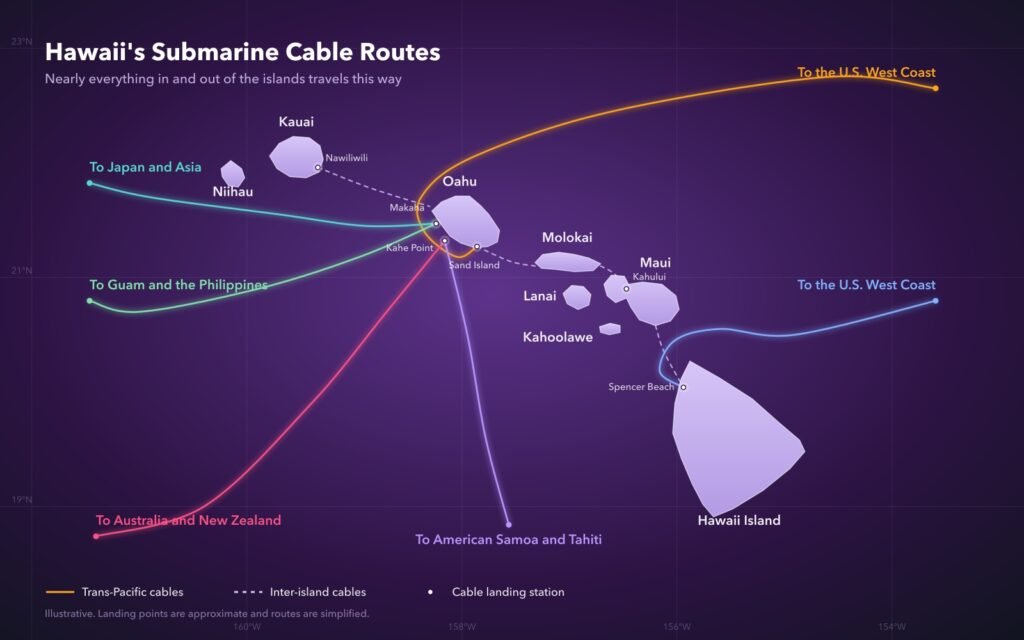
Nearly Everything Leaves on a Submarine Cable
Nearly every byte that leaves Hawaii travels through submarine fiber to the mainland or across the Pacific. The islands are connected to each other the same way.
That gives you a floor on latency that no amount of bandwidth fixes. Round trip to the West Coast runs around 60 milliseconds. To the East Coast it’s roughly double that. It’s a law of physics and distance, not a problem with your internet service.
What it affects:
- Voice and video quality. Latency is survivable. Jitter and packet loss are what make a call sound bad, and a long path has more places for both to creep in. This is why the network side of a phone system deserves attention on top of the phone system itself.
- Cloud application feel. A chatty application that makes many small requests will feel slower here than the same application feels in Denver, even on a fast connection.
- Backup and restore windows. Sending data offsite means sending it off island. A restore that a mainland vendor describes in hours can take considerably longer when the data has to come back across the Pacific.
None of that is a reason to avoid the cloud. It’s a reason to plan around it: local copies of what you’d need first in an emergency, and realistic recovery times on paper.
The exception is satellite. Low orbit services like Starlink can pass traffic between satellites and hand it off at a mainland ground station, which means it doesn’t ride the same cable your wired connection does. That’s what makes it a genuine second path instead of one more service sharing the same fiber. For most businesses it isn’t a replacement for a good wired circuit, but as a backup for the day a cable cut or a local outage takes your primary connection down, it’s the most practical option the islands have ever had.
If you want to know what that costs, I can get pricing from the providers we work with, including satellite, and put it next to what a second wired circuit would run. The two are worth comparing before you decide which one is your backup.
Where Your Data Physically Sits
Most businesses never chose a cloud region. Someone signed up, the default was a data center in Virginia or Ohio, and that’s where the data has lived ever since.
There are no major cloud data centers in Hawaii. The closest are on the West Coast, and the difference between a West Coast region and an East Coast one is real and daily for your staff, especially with applications people use all day long.
It’s worth asking your vendors where your data is hosted, and whether a West Coast region is an option. Sometimes it’s a setting at signup that’s expensive to change later, which is exactly why it should come up before you sign rather than after.
Circuits Take Longer Here
Fewer carriers serve the islands than serve a mainland city, and the ones that do have less spare infrastructure to work with. Getting a new circuit installed can involve local loop construction, permits, and equipment that has to be shipped in.
None of that is unusual, and it’s all manageable. It just doesn’t fit the install timelines printed on a national order form. If a mainland salesperson quotes you 30 days for a new circuit in Kapolei or Waimea, treat that as the optimistic case and build your project schedule with room in it.
This gets more pronounced the further you go from Honolulu. Rural Hawaii Island, west Molokai and much of Lanai have fewer options, and the answer is sometimes a different technology rather than a longer wait.
Recovery Planning When You Can’t Drive to the Next State
A mainland business that loses a building has options: rent equipment across town, drive to a supplier, or have gear shipped overnight from three states away. Hawaii has none of those on the same timeline.
Hurricane season runs from June through November. Power events, flooding and wildfire have all disrupted island businesses in recent years, sometimes taking out communications along with power. The recovery difference here isn’t the plan on paper. It’s whether the equipment you’d need to execute the plan is already on the island.
So the questions are practical. Do you have spare equipment on hand for the things that would stop you from operating? If your internet connection goes down for a week, is there a second path, even a slower one, like a cellular backup? Can your team work from somewhere else, and has that ever been tested rather than just discussed?
Businesses with sites on more than one island have an advantage here, because one location can back up another. That only works if it’s been set up deliberately.
What to Put in the Contract
You don’t have to accept mainland terms. Most of this is negotiable if you ask before signing:
- Support hours stated in Hawaii time. Not “business hours.” Hawaii time, including when senior engineering is available.
- Escalation timing in Hawaii time. When a problem gets handed to someone more senior, and who can do that at 4pm HST.
- Spares stocked on island. Which parts, on which island, and how you get them after hours.
- The local partner named. Who performs on-site work, which islands they actually cover, and their response time to your specific location.
- Recovery times that account for freight. If the plan depends on a part arriving, the recovery time has to include the barge or the flight, not just the warehouse.
- A hosting location you chose. Where your data sits, and confirmation you can pick the closest region.
A vendor that handles these questions well is showing you they’ve done business here before. A vendor that gets annoyed by them is telling you something too.
Where I Come In
I work with providers that deliver network, cloud, voice and support services, and part of my job is knowing which of them operate in Hawaii in a real way rather than on a coverage map. I’ve lived and worked here long enough to know the difference, and I read support terms in Hawaii time before a client signs them.
If you’re evaluating a vendor now, or you already have a contract you’re not sure covers you where you actually are, let’s go through it together. It usually takes one conversation to find out which assumptions in it were written for somewhere else.